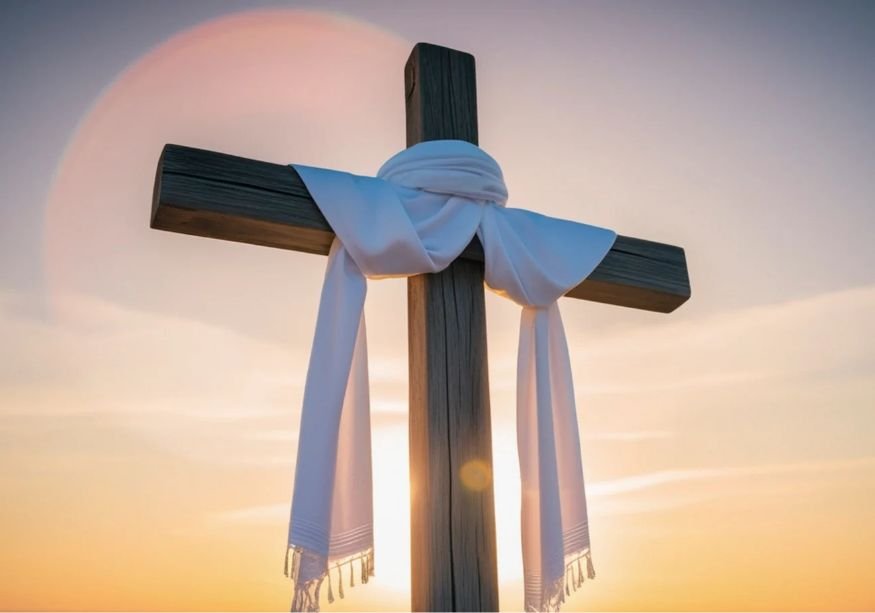
The Cross is the centre of the Catholic faith. Everything flows from it and everything returns to it. It is where justice and mercy met, where death was swallowed by life, where the distance between God and humanity was closed forever.
And yet, for many Catholics, the Cross remains something seen rather than something known. We make the Sign of the Cross dozens of times a week. We look at the crucifix on the wall. We walk past it in church without stopping. The familiarity of it can, over time, dull the weight of what it actually means.
These 15 Bible verses about the Cross are an invitation to stop and look again — not at a symbol, but at a Person, and at what He did for you there.
All verses are taken from the New Revised Standard Version (NRSV) unless otherwise noted. An asterisk (*) indicates words spoken by Jesus.
The Cross as the Power of God
The world has never known what to do with the Cross. To the powerful, it looks like weakness. To the wise, it looks like foolishness. And yet St. Paul insists it is the very power and wisdom of God revealed.
1. 1 Corinthians 1:18
“For the message about the cross is foolishness to those who are perishing, but to us who are being saved it is the power of God.”
This verse reframes everything. The Cross is not a tragedy that God redeemed after the fact. It is the very instrument of salvation — the power of God made visible in what the world considered shameful and weak.
2. 1 Corinthians 2:2
“For I decided to know nothing among you except Jesus Christ, and him crucified.”
Paul wrote this to the church in Corinth — a city of philosophers, intellectuals, and competing ideas. His response was not a more sophisticated argument. It was the Cross. For Paul, the crucified Christ was not one truth among many. It was the truth from which all others derived their meaning.
3. Galatians 6:14
“May I never boast of anything except the cross of our Lord Jesus Christ, by which the world has been crucified to me, and I to the world.”
Paul boasted in the Cross at a time when crucifixion was considered the most humiliating form of death imaginable. His boast was not in his achievements, his heritage, or his knowledge — all of which he had in abundance. It was in the Cross alone. This is the posture every Catholic is called to.
The Cross as the Means of Reconciliation
Sin created a rupture — between humanity and God, between people, within our own hearts. The Cross is where that rupture was healed. These verses show us how.
4. Colossians 1:19-20
“For in him all the fullness of God was pleased to dwell, and through him God was pleased to reconcile to himself all things, whether on earth or in heaven, by making peace through the blood of his cross.”
The scope of what happened on the Cross is staggering. It was not a local or temporary event. It was a cosmic reconciliation — all things, in heaven and on earth, brought back into right relationship with God through the blood of Christ.
5. Ephesians 2:16
“And might reconcile both groups to God in one body through the cross, thus putting to death that hostility through it.”
Paul is writing here about the reconciliation of Jews and Gentiles — two groups divided by centuries of hostility. The Cross abolished that division. The same principle applies to every division we carry: between ourselves and God, between ourselves and those who have hurt us, between ourselves and who we were made to be.
6. Romans 5:8
“But God proves his love for us in that while we still were sinners Christ died for us.”
This is perhaps the most important word in this verse: while. Not after we improved. Not after we repented. Not after we earned it. While we were still sinners. The Cross is the proof that God’s love for you is not contingent on your performance.
Jesus on the Cross: His Own Words
Jesus spoke seven times from the Cross. Each word is a window into His heart. Here are three that every Catholic should carry.
7. Luke 23:34
“Father, forgive them; for they do not know what they are doing.” *
His first word from the Cross was not a cry of pain or a condemnation of His executioners. It was intercession. In the midst of the greatest injustice in history, Jesus prayed for the people killing Him. This is not human — it is divine. And it is the model He gives us for how to respond to those who wound us.
8. John 19:28
“I am thirsty.” *
Two words. The shortest of the seven last words from the Cross. And yet they carry an infinite depth. The one who told the woman at the well that He could give living water so that she would never thirst again — that same Person, hanging on the Cross, says: I am thirsty. He took on our thirst, our need, our poverty, our hunger. He became what we are so that we could become what He is.
9. John 19:30
“It is finished.” *
In Greek, this is a single word: tetelestai. It was a word used in commerce to mean a debt had been paid in full. Jesus was not saying His life was over. He was saying that the work of redemption — the payment of the debt of sin that humanity owed — was complete. Nothing more needs to be added. Nothing can be taken away. It is finished.
The Call to Take Up the Cross
The Cross is not only something that happened to Jesus. It is something He invites every one of His followers to embrace in their own lives. These verses show what that means.
10. Matthew 16:24
“If any want to become my followers, let them deny themselves and take up their cross and follow me.” *
Jesus does not say “if any want to follow me, life will become comfortable.” He says it will involve a cross. The cross He speaks of here is not suffering in the abstract — it is the particular weight that belongs to your life: the illness, the difficult relationship, the unfulfilled longing, the daily dying to what you want so that God can have what He wants. That is the cross He is asking you to pick up and carry — not once, but daily.
11. Luke 9:23
“If any want to become my followers, let them deny themselves and take up their cross daily and follow me.” *
Luke adds one word that Matthew does not include: daily. The cross is not a one-time event in the spiritual life. It is a daily practice. Every morning brings a fresh opportunity to choose God over self, to choose the narrow road over the comfortable one, to choose love over comfort.
12. Philippians 3:18
“For many live as enemies of the cross of Christ; I have often told you of them, and now I tell you even with tears.”
Paul wept as he wrote this. Not with anger but with grief. To live as an enemy of the Cross is not necessarily to reject Jesus outright. It is to live for comfort, for pleasure, for self — while calling yourself a Christian. Paul’s tears are a pastoral warning to every Catholic who is tempted to carry a lighter cross than the one Christ offers.
The Cross and Our Identity
The Cross does not only tell us what Jesus did. It tells us who we now are because of what He did.
13. Galatians 2:19-20
“I have been crucified with Christ; and it is no longer I who live, but it is Christ who lives in me. And the life I now live in the flesh I live by faith in the Son of God, who loved me and gave himself for me.”
This is one of the most extraordinary statements in all of Scripture. Paul does not say he follows Christ or admires Christ or believes in Christ. He says he has been crucified with Christ. His old self — the self that lived for its own agenda, its own justification, its own glory — died with Jesus on the Cross. What remains is a life animated by Christ Himself. This is what Baptism means. This is what every Catholic is called to live.
14. Romans 6:6
“We know that our old self was crucified with him so that the body of sin might be destroyed, and we might no longer be enslaved to sin.”
The Cross is the source of your freedom from sin. Not willpower. Not good intentions. Not trying harder. The old self that was enslaved to sin was nailed to the Cross with Christ. This is not a metaphor to be admired — it is a reality to be lived into, day by day, through prayer, the sacraments, and the choices of ordinary life.
15. Isaiah 53:5
“But he was wounded for our transgressions, crushed for our iniquities; upon him was the punishment that made us whole, and by his bruises we are healed.”
Written seven centuries before Christ, Isaiah 53 is one of the most astonishing passages in the Old Testament. The prophet describes with striking precision what would happen on Calvary: the wounds, the crushing, the punishment, and above all the purpose of it all — that we might be made whole. By His bruises we are healed. Not might be. Not could be. Are healed. The Cross is not a possibility — it is a completed act of love on your behalf.
A Prayer at the Foot of the Cross
Lord Jesus, I stand at the foot of Your Cross.
I have looked at it so many times without truly seeing it. I have made the Sign of the Cross without pausing to consider what it cost You. Forgive me for the familiarity that has dulled me to the weight of what You did.
Today I want to see it clearly. You were wounded for my transgressions. You were crushed for my iniquities. The punishment that should have been mine fell on You, so that I could be made whole. By Your bruises — real wounds, real blood, real suffering — I am healed.
Help me to take up my own cross daily and follow You. Help me not to run from the weight of it, but to carry it as You did — with trust in the Father, with love for those around me, and with the certainty that resurrection follows Calvary.
It is finished, You said. Let that finished work be fully alive in me.
Amen.