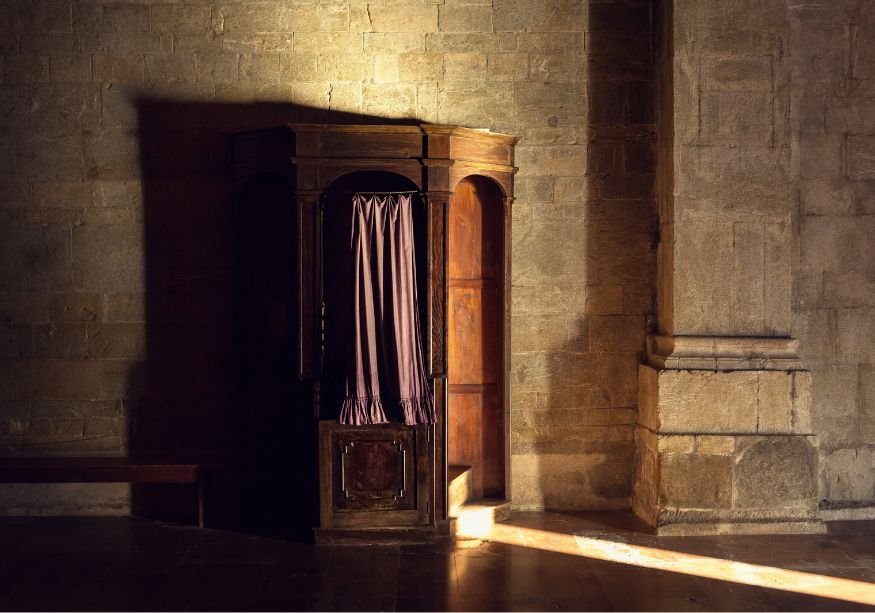
Many Catholics carry a quiet anxiety about Confession. Some have been away for years and do not know how to return. Others go regularly but wonder if they are doing it properly. Some feel shame before they even walk through the door.
This guide is for all of them. It walks through every step of a good Confession clearly and practically — from preparation at home to the moment you walk out of the confessional. There is nothing to be afraid of. The Sacrament of Reconciliation is one of the greatest gifts Christ left His Church, and it is available to you right now.
What Is the Sacrament of Confession?
Confession — also called the Sacrament of Reconciliation or Penance — is the sacrament through which Catholics receive God’s forgiveness for sins committed after Baptism. It is not a ritual invented by the Church. It was instituted by Jesus Christ Himself on the evening of His Resurrection:
“Receive the Holy Spirit. If you forgive the sins of any, they are forgiven them; if you retain the sins of any, they are retained.” — Jn 20:22-23
When a priest absolves you in the confessional, it is Christ who is acting through him. The priest is the instrument. The forgiveness is God’s.
The Catechism of the Catholic Church calls this sacrament “the sacrament of conversion” and “the sacrament of forgiveness” — because in it, God does not merely overlook what we have done. He restores the relationship. He wipes the slate clean. He welcomes us back.
What Makes a Confession Valid?
The Church identifies five essential elements of a good Confession. Think of them as the conditions that make the sacrament real and fruitful rather than just a recitation of words.
1. Examination of Conscience
Before going to Confession, you take time to honestly review your thoughts, words, actions, and omissions since your last Confession. You are not performing for God — He already knows everything. This examination is for your sake, so that you can bring your sins clearly and honestly before Him.
2. Contrition
This is sorrow for your sins. The Church distinguishes between perfect contrition — sorrow because you love God and have offended Him — and imperfect contrition, sometimes called attrition, which is sorrow motivated by fear of punishment or an awareness that sin is wrong. Both are sufficient for a valid Confession, though perfect contrition is the deeper disposition to aim for.
3. Firm Purpose of Amendment
This means a sincere intention not to sin again and to avoid whatever leads you into sin. It does not mean you are promising never to fall again — God knows our weakness. It means you are genuinely resolved to try, and that you are not walking into the confessional planning to repeat the same sin tomorrow.
4. Confession of Sins to a Priest
You must confess all mortal sins — by kind and number, as best you can recall — to a validly ordained Catholic priest. Venial sins should also be confessed as a matter of good practice and spiritual growth, though they are not strictly required for the validity of the sacrament.
5. Satisfaction (Penance)
The priest will give you a penance — usually a set of prayers or a small act of charity or service. This is not a punishment. It is a participation in the healing process, a concrete act through which you cooperate with the grace of the sacrament and make some reparation for the harm your sin has caused.
Step 1: Examine Your Conscience
Set aside some quiet time before your Confession — even fifteen minutes is enough. Find a peaceful place, ask the Holy Spirit to help you see yourself clearly, and then reflect honestly on your life since your last Confession.
A good examination of conscience follows the Ten Commandments, the precepts of the Church, and the teachings of the Gospel. Here are some questions to guide you:
In Relation to God
Have I received Communion in a state of mortal sin? Have I neglected prayer entirely for long periods? Have I placed other things — work, money, comfort, another person — above God in a way that has become idolatrous? Have I used God’s name irreverently?
In Relation to Others
Have I harmed anyone through my words — gossip, slander, harsh criticism, lies? Have I been dishonest in work or financial matters? Have I stolen, cheated, or failed to repay what I owe? Have I held serious grudges or refused to forgive? Have I failed in my duties to my family — as a spouse, parent, or child? Have I caused scandal by encouraging others to sin?
In Relation to Myself
Have I acted against the virtue of chastity — in thought, word, or deed? Have I abused alcohol or other substances? Have I been driven by pride, envy, or anger in ways that have damaged my relationships or my spiritual life? Have I been negligent about my own growth in faith?
You do not need to construct an exhaustive list. Be thorough but calm. Remember that you are not preparing a legal document — you are preparing your heart.
Step 2: Feel Genuine Sorrow
After your examination, spend a moment simply sitting with what you have found. Do not rush past this step. Contrition is not a feeling you manufacture — it is a response to the truth. When you see clearly what you have done, and when you hold it before God’s love and goodness, sorrow arises naturally.
If you find it hard to feel sorry, be honest about that too. You can pray: “Lord, I do not feel the sorrow I should. Give me a heart that grieves what grieves You.” This itself is a form of contrition — the recognition that your heart needs softening and the willingness to ask for it.
Step 3: Go to Confession
Most parishes offer Confession on Saturday afternoons, and many offer it at other times during the week. Some priests are also available by appointment. If you are unsure when your parish holds Confession, call the parish office or check the website.
You will usually have a choice between confessing anonymously behind a screen or face to face with the priest. Both are valid. Choose whichever helps you speak more freely and honestly.
When You Enter the Confessional
Begin by making the Sign of the Cross. You can then say: “Bless me, Father, for I have sinned. It has been [length of time] since my last Confession.” If it has been a very long time — years or even decades — simply say so. The priest will not be surprised or shocked. He has heard it many times.
Confessing Your Sins
Confess your sins simply and honestly. You do not need to narrate the whole story — just name what you did, and where relevant, how many times. For example: “I have been dishonest with my spouse on several occasions.” You do not need to justify, explain, or perform. Speak plainly.
When you have finished, you can say: “I am sorry for these and all the sins of my past life.”
Listening to the Priest
The priest may offer a brief word of counsel, ask a clarifying question, or simply give you your penance and invite you to make an Act of Contrition. Listen to him. He is not there to judge you — he is there as an instrument of Christ’s mercy. His role is to absolve, not to condemn.
The Act of Contrition
The Act of Contrition is a short prayer expressing your sorrow and your intention to amend your life. There are several traditional forms. One of the most commonly used is:
O my God, I am heartily sorry for having offended You, and I detest all my sins because of Your just punishments, but most of all because they offend You, my God, who are all good and deserving of all my love. I firmly resolve, with the help of Your grace, to sin no more and to avoid the near occasions of sin. Amen.
The Absolution
The priest will then extend his hand over you and pronounce the words of absolution:
“God, the Father of mercies, through the death and resurrection of his Son has reconciled the world to himself and sent the Holy Spirit among us for the forgiveness of sins; through the ministry of the Church may God give you pardon and peace, and I absolve you from your sins in the name of the Father, and of the Son, and of the Holy Spirit.”
You respond: “Amen.”
At that moment, your sins are forgiven. Completely. Not partially — completely. The Catechism says: “The whole power of the sacrament of Penance consists in restoring us to God’s grace and joining us with him in an intimate friendship” (CCC 1468).
Step 4: Complete Your Penance
After leaving the confessional, complete the penance the priest gave you as soon as possible — ideally before you leave the church. If it was a set of prayers, pray them slowly and with attention rather than rushing through them. They are not a formality. They are a participation in your own healing.
Take a few minutes to simply sit in the presence of God and give thanks. You have just received an extraordinary gift. Let it land.
What If I Have Been Away for a Long Time?
This is one of the most common situations priests encounter, and it is one they are always glad to help with. If you have been away from Confession for years, you do not need to remember every sin in perfect detail. Do your best with your examination of conscience, confess what you recall honestly, and mention how long it has been. The priest may walk you through it more slowly. Let him.
The parable of the Prodigal Son is the best picture of what awaits you. The father does not wait for the son to finish his prepared speech. He sees him coming from a distance and runs to meet him. That is the God who is waiting for you in this sacrament.
Common Questions About Confession
What is a mortal sin?
A mortal sin is a serious offence against God that completely breaks our relationship with Him. For a sin to be mortal, three conditions must be met: it must involve grave matter, it must be committed with full knowledge that it is gravely wrong, and it must be committed with deliberate consent. Examples of grave matter include serious sexual sins, grave dishonesty, and acts of violence. Mortal sins must be confessed to a priest before receiving Communion.
What is a venial sin?
A venial sin weakens but does not destroy our relationship with God. It may involve a less serious matter, or a serious matter where full knowledge or full consent was lacking. Venial sins can be forgiven through prayer, acts of charity, and receiving the Eucharist — but confessing them regularly is a beautiful and valuable spiritual practice that deepens self-awareness and grows in grace.
Does the priest have to keep what I say secret?
Yes, absolutely. The seal of the confessional is absolute and inviolable. A priest may never, under any circumstances, reveal anything heard in Confession — to anyone, for any reason. This is one of the most strictly held obligations in the entire Catholic Church. What you say in the confessional stays in the confessional, always.
What if I forget a sin?
If you genuinely forgot a sin — not deliberately withheld it, but simply could not recall it — it is still forgiven in the absolution. If you remember it later, you can mention it at your next Confession. God does not hold honest forgetfulness against you.
How often should I go to Confession?
The Church requires Catholics to confess serious sins at least once a year. But many saints and spiritual directors recommend going once a month, or even more frequently for those who take their spiritual life seriously. Regular Confession — even when you have no mortal sins to confess — is one of the most powerful tools available for spiritual growth. It sharpens the conscience, builds humility, and opens the soul to grace.
A Prayer Before Confession
Lord Jesus, I come before You not because I deserve to, but because You have invited me. You know everything I have done, every way I have fallen short, every time I have chosen myself over You and over others. I am not here to hide any of it.
Give me the grace of true sorrow — not just fear of what my sins deserve, but a real grief that I have offended You, who are all goodness and all love. Open my heart to speak honestly, to hold nothing back, and to receive Your mercy without reservation.
I believe that when the priest speaks the words of absolution, it is Your voice I am hearing. I believe that what You forgive is truly forgiven. Help me to receive that forgiveness fully — and to walk out of this sacrament truly new.
Amen