There is a practice in the Catholic Church that has quietly transformed millions of lives and yet remains unfamiliar to many Catholics. It requires no special training, no particular talent, and no elaborate preparation. It asks only that you show up and be present. It is called Eucharistic Adoration, and it is one of the most powerful forms of prayer available to a Catholic.
This guide will walk you through everything you need to know — what Adoration is, what happens during it, what the Church teaches about it, how to prepare, and what to actually do when you are there.
What Is Eucharistic Adoration?
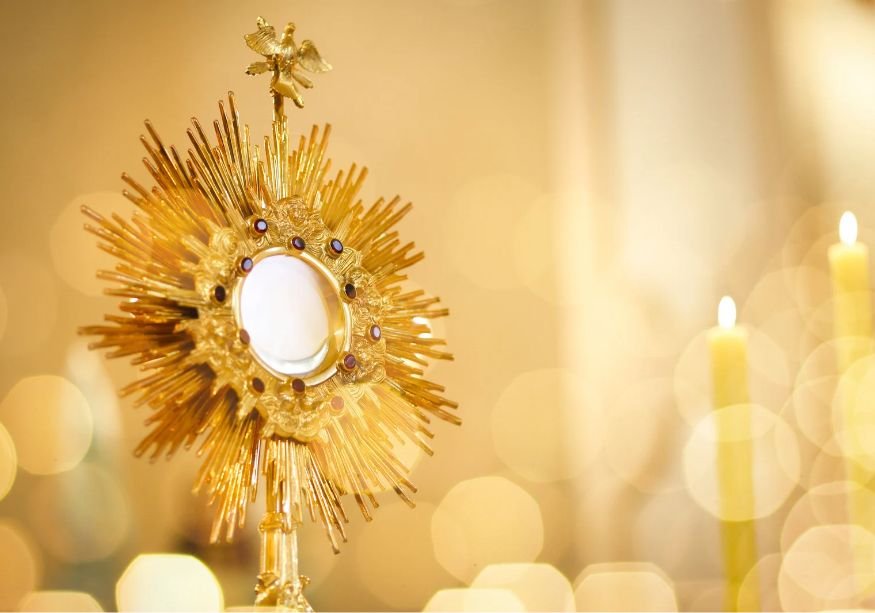
Eucharistic Adoration is the practice of worshipping Jesus Christ as He is truly present in the Blessed Sacrament — the consecrated host placed in a vessel called a monstrance and exposed for the faithful to see, pray before, and adore.
The word “adoration” comes from the Latin adoratio, meaning to offer worship or homage. In Catholic understanding, adoration in the fullest sense is given to God alone. Because the Catholic Church teaches that Jesus is truly, really, and substantially present — Body, Blood, Soul, and Divinity — in the consecrated Eucharist, sitting before the Blessed Sacrament is not a symbolic act. It is a direct encounter with the living God.
This is the heart of Adoration. You are not praying toward an object. You are sitting in the presence of a Person.
The Real Presence: The Foundation of Adoration
To understand Adoration, you first need to understand what Catholics believe about the Eucharist. At Mass, when the priest speaks the words of consecration over the bread and wine, something extraordinary takes place. The substance of the bread and wine is completely transformed into the Body and Blood of Jesus Christ. The appearances of bread and wine remain, but what they are has changed entirely. The Church calls this transubstantiation.
This is not a metaphor or a symbol. The Catechism of the Catholic Church states clearly: “The mode of Christ’s presence under the Eucharistic species is unique… In the most blessed sacrament of the Eucharist ‘the body and blood, together with the soul and divinity, of our Lord Jesus Christ and, therefore, the whole Christ is truly, really, and substantially contained'” (CCC 1374).
Because of this, the consecrated host does not lose its sacred character after Mass. Jesus remains present in the Eucharist. This is why the Church reserves the Blessed Sacrament in the tabernacle — the golden box you see at the front of every Catholic church, often marked by a lit candle or lamp nearby. And it is why Adoration is possible at all. When the host is placed in the monstrance, Jesus is exposed for us to encounter in a direct and intimate way.
Jesus Himself spoke about this in John 6: “I am the living bread that came down from heaven. Whoever eats this bread will live forever; and the bread that I will give is my flesh for the life of the world” (Jn 6:51). The Early Church Fathers, including St. Ignatius of Antioch, St. Justin Martyr, and St. Cyril of Jerusalem, all wrote about the Real Presence in the Eucharist — confirming that this has been the faith of the Church from the beginning.
The History of Eucharistic Adoration
The roots of Adoration go back to the early centuries of the Church, when great reverence was shown to the reserved Eucharist. But the formal practice of exposing the Blessed Sacrament for public veneration developed more fully during the medieval period, partly in response to growing debates about the nature of Christ’s presence in the Eucharist.
The feast of Corpus Christi — the celebration of the Body and Blood of Christ — was established in the thirteenth century, largely through the efforts of St. Thomas Aquinas, who composed some of the Church’s most beautiful Eucharistic hymns, including the Tantum Ergo and the Pange Lingua, which are still sung at Adoration and Benediction today.
Many of the Church’s greatest saints were devoted practitioners of Eucharistic Adoration. St. Peter Julian Eymard, known as the Apostle of the Eucharist, founded a religious congregation dedicated entirely to perpetual adoration in the nineteenth century. St. John Paul II made Adoration a cornerstone of his personal spirituality and encouraged all Catholics to rediscover it. St. Teresa of Calcutta — Mother Teresa — required her Missionaries of Charity to spend one hour before the Blessed Sacrament every day, famously saying that the time spent in Adoration was the source of everything they did for the poor.
Types of Adoration
Exposition and Benediction
This is a formal liturgical service. The priest or deacon exposes the Blessed Sacrament in the monstrance, leads prayers, hymns, and sometimes a period of silent adoration, and concludes by blessing the congregation with the host. The Tantum Ergo is traditionally sung before the final blessing. It is a complete and beautiful service, usually lasting between thirty minutes and an hour.
Holy Hour
A Holy Hour is simply one hour spent in prayer before the Blessed Sacrament. The name comes from Jesus’ words to the disciples in Gethsemane: “Could you not watch one hour with me?” (Mt 26:40). Many Catholics commit to a regular Holy Hour each week. It can be structured or unstructured — a combination of Scripture reading, the Rosary, journalling, intercessory prayer, and silent contemplation.
Perpetual Adoration
Some parishes and religious communities maintain perpetual Adoration — the Blessed Sacrament is exposed twenty-four hours a day, seven days a week, and parishioners sign up for hour-long slots to ensure that Jesus is never left alone. If your parish has a perpetual Adoration chapel, it is one of the great gifts available to you.
Visits to the Blessed Sacrament
Even when the Blessed Sacrament is not formally exposed in a monstrance, you can visit any Catholic church, kneel before the tabernacle, and pray in the presence of Jesus. These informal visits — even fifteen minutes between errands — carry the same spiritual reality. The host is reserved, not exposed, but He is just as present.
What the Church Teaches About Adoration
The Catholic Church has consistently and strongly encouraged Eucharistic Adoration throughout its history. Several popes have written specifically about it.
Pope Paul VI, in his encyclical Mysterium Fidei (1965), reaffirmed the Church’s teaching on the Real Presence and encouraged the faithful to visit the Blessed Sacrament regularly, calling it “a proof of gratitude, a pledge of love, and a duty of adoration.”
St. John Paul II wrote extensively about Adoration. In Ecclesia de Eucharistia (2003), he reflected on how the Church draws her life from the Eucharist, and he personally modelled daily Adoration throughout his pontificate. He called it “the school of love.”
Pope Benedict XVI, a profound theologian of the Eucharist, encouraged parishes to establish Adoration chapels and wrote that “the act of adoration outside Mass prolongs and intensifies all that takes place during the liturgical celebration itself.”
Pope Francis has spoken about Adoration as a place to bring all of our burdens: “Go to adoration. Stay there in silence before that presence which is all love.”
The Spiritual Benefits of Adoration
Catholics who practise regular Adoration consistently describe it as one of the most transformative habits in their spiritual life. Here is what it tends to produce over time.
Deep Interior Peace
There is something that happens in the silence of an Adoration chapel that is difficult to explain and impossible to manufacture elsewhere. The noise of daily life — anxiety, distraction, to-do lists, unresolved tensions — gradually quiets. Many people describe leaving Adoration feeling a peace that was not there when they arrived, even if nothing in their circumstances has changed.
Clarity and Discernment
Major decisions brought before the Blessed Sacrament have a way of becoming clearer. Not always immediately, and not always in the way we expect — but the regular practice of sitting in silence before God tends to produce a growing ability to hear His voice and distinguish it from our own preferences and fears.
Healing
Many people have experienced significant emotional and spiritual healing through regular Adoration. Wounds that years of ordinary effort had not been able to touch have been reached in the quiet of an Adoration chapel. This is not magic — it is the natural result of sustained exposure to the love of God.
Growth in Love for Others
Mother Teresa’s observation that the fruit of Adoration was charity is borne out again and again. Time spent in the presence of Jesus — who is Love itself — tends to make a person more loving. The impatience, self-absorption, and irritability that mark a life without prayer gradually give way to a gentleness and generosity that cannot be produced by willpower alone.
Deeper Participation in Mass
Those who practise Adoration regularly report that the Mass comes alive for them in a new way. When you have spent time simply being present before Jesus in the Eucharist, your understanding of what is happening at the altar is transformed. The Mass is no longer a ritual to be observed — it is a personal encounter to be entered.
How to Prepare for Adoration
You do not need elaborate preparation to go to Adoration. Jesus does not require you to arrive with a polished prayer list or a theological degree. But a little intentionality helps, especially in the beginning.
Find Out Where and When
Check with your local parish or diocese to find out when Adoration is held. Many parishes offer it for an hour or two after daily Mass. Some have weekly Holy Hours on a fixed evening. A growing number have perpetual Adoration chapels that are open around the clock. If your nearest parish does not have Adoration, any Catholic church is a place where you can visit the tabernacle.
Bring What Helps You Pray
You might bring a Bible, a Rosary, a journal, or a book of Catholic prayers. The Magnificat, a monthly booklet of daily prayers and Mass readings, is popular in Adoration chapels. Some people bring nothing at all and simply sit in silence. There is no wrong approach.
Arrive with an Open Heart
The most important thing you bring to Adoration is your willingness to be present. You do not need to feel holy or prayerful. You do not need to leave your problems at the door. You can bring everything — the confusion, the grief, the distraction, the doubt — and simply place it before Him. He already knows it all anyway.
What to Do During Adoration
This is the question most people have when they first go. The answer is: whatever draws you into prayer. But here are some suggestions, particularly for those who are just beginning.
Begin with an Act of Faith
When you arrive, genuflect before the Blessed Sacrament — both knees on the ground if the host is exposed in the monstrance — as an act of reverence and recognition. Then settle in and begin with a simple prayer acknowledging who is before you. The traditional Act of Faith, or simply your own words, works well: “Lord, I believe You are truly present here. I am here with You.”
Spend Time in Silence
Do not fill every moment with words or devotional reading. Allow yourself to simply be still. This is harder than it sounds — the mind will wander, and that is normal. Each time it does, gently bring it back. Over time, this practice of returning to the presence of God trains the soul in a way that spoken prayer alone cannot.
Read Scripture
Choose a short passage — a psalm, a section of John’s Gospel, one of Paul’s letters — and read it slowly. Read it again. Let a word or phrase catch your attention and sit with it. This ancient form of prayerful Scripture reading, called lectio divina, is particularly well suited to Adoration.
Bring Your Intentions
Adoration is a powerful place for intercessory prayer. Bring the people you are worried about, the situations that seem impossible, the needs of your family, your parish, and the world. Place them before Jesus and trust that He hears you.
Simply Rest
Sometimes — especially in seasons of exhaustion or desolation — the holiest thing you can do in Adoration is simply rest. You do not need to produce anything. St. John Vianney famously told a parishioner who said he did nothing but look at the tabernacle: “That is enough. He looks at you and you look at Him.” That exchange of gazes is its own form of prayer.
Common Questions About Adoration
Do I have to stay for a full hour?
No. Even fifteen or twenty minutes before the Blessed Sacrament is deeply worthwhile, especially when you are just beginning. Start with what is realistic and let the practice grow naturally.
What if I fall asleep?
It happens — especially to the tired and the overworked. St. Thérèse of Lisieux wrote about falling asleep during prayer and trusted that God received it as the sleep of a beloved child in the arms of a father. Do not be discouraged. Come back.
What if I feel nothing?
Feelings are not the measure of prayer. Many of the greatest saints — including St. Teresa of Calcutta, who experienced decades of spiritual darkness — continued to pray before the Blessed Sacrament in the absence of any consolation. The value of Adoration does not depend on what you feel during it. It depends on the reality of who is there.
Can I go to Adoration if I am in a state of mortal sin?
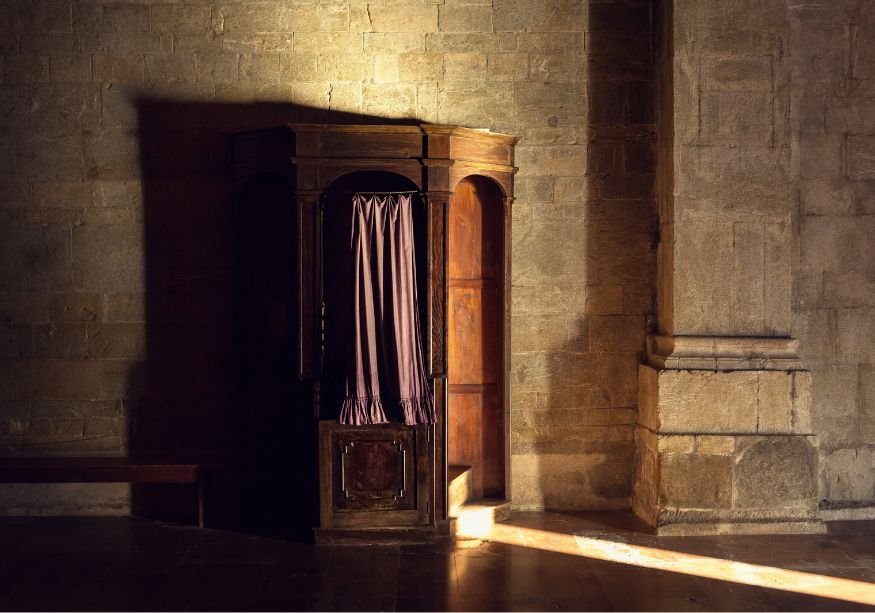
Yes. In fact, Adoration can be a powerful place to receive the grace of contrition that leads you to Confession. Come as you are.
A Prayer Before the Blessed Sacrament
Lord Jesus, I believe that You are truly present here — Body, Blood, Soul, and Divinity. I come before You not because I have it all together, but because I know that You are the one place where I can bring everything I am and everything I carry.
Speak to me in this silence. Heal what I have not been able to heal on my own. Give me the grace to simply be still and know that You are God.
I offer You my time, my attention, and my heart. Do with them whatever You will. I trust that this hour — however dry, however distracted, however imperfect — is not wasted when it is spent with You.
Stay with me, Lord. And teach me to stay with You.
Amen.