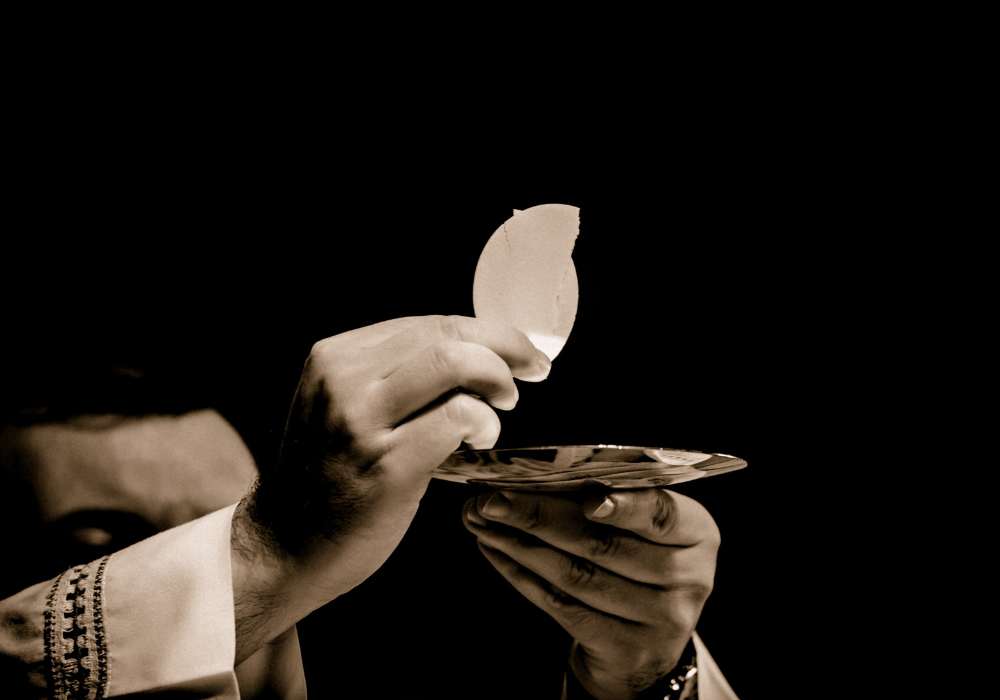
The Eucharist is the source and summit of the Christian life. That is not a pious phrase — it is the Catholic Church’s most precise statement about what matters most. Every Mass, every reception of Holy Communion, every moment of Eucharistic adoration draws its meaning from what Scripture reveals about the Body and Blood of Jesus Christ.
Yet many Catholics have never sat with the Bible verses that form the foundation of this belief. These 20 Bible verses about the Eucharist will ground your faith in Scripture, deepen your understanding of what happens at Mass, and help you approach the altar with greater reverence and awe.
1. The Institution of the Eucharist
The Eucharist was not invented by the Church. It was given by Christ Himself, on the night before He died, in words so deliberate and so clear that they have anchored Christian worship for two thousand years.
1. “While they were eating, Jesus took a loaf of bread, and after blessing it he broke it, gave it to the disciples, and said, ‘Take, eat; this is my body.’ Then he took a cup, and after giving thanks he gave it to them, saying, ‘Drink from it, all of you; for this is my blood of the covenant, which is poured out for many for the forgiveness of sins.'” — Mt 26:26-28
2. “Then he took a loaf of bread, and when he had given thanks, he broke it and gave it to them, saying, ‘This is my body, which is given for you. Do this in remembrance of me.’ And he did the same with the cup after supper, saying, ‘This cup that is poured out for you is the new covenant in my blood.'” — Lk 22:19-20
3. “While they were eating, he took a loaf of bread, and after blessing it he broke it, gave it to them, and said, ‘Take; this is my body.’ Then he took a cup, and after giving thanks he gave it to them, and all of them drank from it. He said to them, ‘This is my blood of the covenant, which is poured out for many.'” — Mk 14:22-24
Three of the four Gospels record the institution of the Eucharist using nearly identical language. Jesus does not say this bread represents my body, or this bread is a symbol of my body. He says: this is my body. The directness of the language is deliberate and it is the foundation of Catholic teaching on the Real Presence.
2. The Bread of Life Discourse
The sixth chapter of John’s Gospel is the most extended teaching Jesus gives on the Eucharist. It is important to note that He gives it a full year before the Last Supper — long before He instituted the sacrament — yet the language He uses is unmistakable.
4. “I am the bread of life. Whoever comes to me will never be hungry, and whoever believes in me will never be thirsty.” — Jn 6:35
5. “I am the living bread that came down from heaven. Whoever eats of this bread will live forever; and the bread that I will give for the life of the world is my flesh.” — Jn 6:51
6. “Very truly, I tell you, unless you eat the flesh of the Son of Man and drink his blood, you have no life in you. Those who eat my flesh and drink my blood have eternal life, and I will raise them up on the last day.” — Jn 6:53-54
7. “For my flesh is true food and my blood is true drink. Those who eat my flesh and drink my blood abide in me, and I in them.” — Jn 6:55-56
When the crowd found this teaching too hard to accept and began to walk away, Jesus did not soften His words or clarify that He had been speaking symbolically. He let them leave. He then turned to His disciples and asked: “Do you also wish to go away?” (Jn 6:67). The teaching stood as given. The Catholic Church has always taken it at face value.
3. The Eucharist as Communion and Covenant
8. “The cup of blessing that we bless, is it not a sharing in the blood of Christ? The bread that we break, is it not a sharing in the body of Christ?” — 1 Cor 10:16
9. “Because there is one bread, we who are many are one body, for we all partake of the one bread.” — 1 Cor 10:17
Paul here uses the Greek word koinonia — communion, participation, sharing. To receive the Eucharist is not merely to consume something. It is to enter into a union with Christ and, through Him, with every other member of His Body. This is why the Eucharist is inseparable from the Church.
10. “For I received from the Lord what I also handed on to you, that the Lord Jesus on the night when he was betrayed took a loaf of bread, and when he had given thanks, he broke it and said, ‘This is my body that is for you. Do this in remembrance of me.’ In the same way he took the cup also, after supper, saying, ‘This cup is the new covenant in my blood. Do this, as often as you drink it, in remembrance of me.'” — 1 Cor 11:23-25
This passage in 1 Corinthians is the earliest written account of the institution of the Eucharist in all of the New Testament, predating the Gospels. Paul’s language — “I received from the Lord what I also handed on to you” — reflects the transmission of sacred Tradition from the very beginning of the Church.
4. The Eucharist and the Resurrection
11. “When he was at the table with them, he took bread, blessed and broke it, and gave it to them. Then their eyes were opened, and they recognised him; and he vanished from their sight.” — Lk 24:30-31
The disciples on the road to Emmaus walked with the risen Christ for hours without recognising Him. It was in the breaking of bread that they knew who He was. The early Church saw in this scene a direct reference to the Eucharist — the place where the risen Lord makes Himself known to His people in a unique and irreplaceable way.
12. “Those who eat my flesh and drink my blood have eternal life, and I will raise them up on the last day.” — Jn 6:54
Jesus connects the Eucharist directly to the resurrection of the body. What we receive at the altar is not only spiritual nourishment for now — it is a pledge and a foretaste of eternal life.
5. Old Testament Foreshadowings of the Eucharist
The Eucharist does not appear in the New Testament without preparation. The Old Testament is filled with foreshadowings — images and events that point forward to the gift Christ would give at the Last Supper.
13. “He rained down on them manna to eat, and gave them the grain of heaven. Mortals ate of the bread of angels; he sent them food in abundance.” — Ps 78:24-25
14. “I am going to rain bread from heaven for you, and each day the people shall go out and gather enough for that day.” — Ex 16:4
Jesus explicitly draws on the image of manna in the Bread of Life discourse: “Your ancestors ate the manna in the wilderness, and they died. This is the bread that comes down from heaven, so that one may eat of it and not die” (Jn 6:49-50). The manna sustained Israel in the desert. The Eucharist sustains the Church on its journey toward heaven.
15. “Melchizedek king of Salem brought out bread and wine; he was priest of God Most High.” — Gen 14:18
The mysterious figure of Melchizedek — a priest-king who offers bread and wine — is understood by the Church as a foreshadowing of Christ, the eternal high priest whose offering at the Last Supper and on the Cross is made present in every Mass.
16. “The Passover of the Lord begins at twilight on the fourteenth day of the first month.” — Lev 23:5
The Eucharist is the fulfilment of the Passover. Jesus institutes it during the Passover meal. He is the Lamb of God whose blood marks the doorposts of the soul and whose flesh is eaten as the source of salvation — not from Egypt, but from sin and death.
6. Receiving the Eucharist Worthily
17. “Whoever, therefore, eats the bread or drinks the cup of the Lord in an unworthy manner will be answerable for the body and blood of the Lord. Examine yourselves, and only then eat of the bread and drink of the cup.” — 1 Cor 11:27-28
Paul’s warning here is striking. He does not say that receiving unworthily is merely impious or disrespectful. He says it makes a person “answerable for the body and blood of the Lord” — language that only makes sense if what is being received is truly the body and blood of Christ. This passage has always formed part of the Church’s teaching on the importance of being in a state of grace before receiving Communion.
18. “For all who eat and drink without discerning the body, eat and drink judgment against themselves.” — 1 Cor 11:29
To discern the body is to recognise, with faith and reverence, what is truly present in the Eucharist. This is why the Church emphasises preparation for Mass, a proper fast, examination of conscience, and — where serious sin is present — the reception of the Sacrament of Reconciliation before approaching Communion.
7. The Eucharist and Eternal Life
19. “Just as the living Father sent me, and I live because of the Father, so whoever eats me will live because of me.” — Jn 6:57
20. “As often as you eat this bread and drink the cup, you proclaim the Lord’s death until he comes.” — 1 Cor 11:26
Every Mass is an proclamation. Not simply a remembrance of something that happened two thousand years ago, but a making-present of the one eternal sacrifice of Christ — looking back to the Cross, and forward to His coming again. The Eucharist holds past, present, and future together in a single act of worship.
A Prayer Before Holy Communion
Lord Jesus Christ, I approach Your altar with unworthiness and yet with longing. I believe, with the whole Catholic Church, that what I am about to receive is truly Your Body, Your Blood, Your Soul, and Your Divinity — the same Christ who was born of Mary, who died on the Cross, and who rose from the dead on the third day.
I am not worthy that You should enter under my roof. But You have invited me here. You have said: unless you eat my flesh and drink my blood, you have no life in you. And so I come – not trusting in my own goodness, but in Your mercy alone.
As I receive You today, increase my faith. Deepen my reverence. Let this Holy Communion draw me closer to You, unite me more fully to Your Body the Church, and be for me, as You have promised, the pledge of eternal life.
Amen.