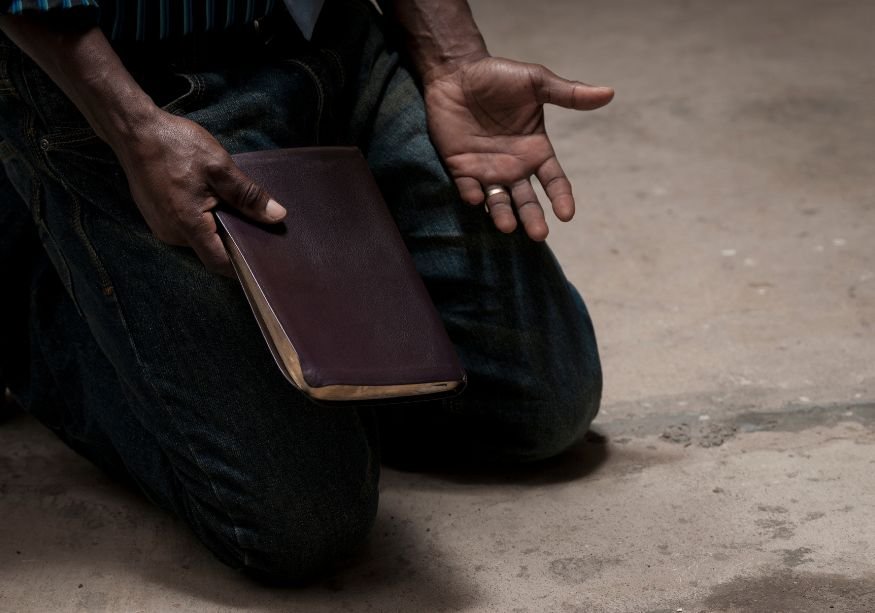
You sit down to pray and nothing happens. No sense of God’s presence. No warmth, no consolation, no feeling that anyone is listening. You say the words and they seem to bounce off the ceiling. You read Scripture and it feels flat. You go to Mass and leave feeling exactly as you arrived.
If this is where you are, you are not alone — and you are not failing at prayer. Some of the greatest saints in the history of the Church walked through exactly this experience, some of them for years at a time. What you are going through has a name, it has a purpose, and there is a way through it.
This guide is for Catholics who want to keep praying even when prayer feels empty.
What Is Spiritual Dryness?
The experience of feeling nothing in prayer is called spiritual dryness, or in the language of the mystics, desolation. It is the absence of felt consolation – the warmth, peace, and sense of God’s nearness that can sometimes accompany prayer. In desolation, those feelings are gone, and prayer becomes an act of the will rather than of the heart.
It is important to understand what spiritual dryness is not. It is not evidence that God has abandoned you. It is not a sign that your faith is weak or that you are doing something wrong. It is not the same as losing your faith. And it is almost never permanent.
St. Ignatius of Loyola, who gave the Church one of its most precise maps of the interior life, described desolation as a time when the soul feels separated from God — heavy, restless, without hope or love. But he was clear that God permits this experience for reasons that are good, even when they are not immediately visible to us.
There is a difference, though, between spiritual dryness and clinical depression. If the emptiness you feel extends beyond prayer into every area of your life — if you have lost interest in things you used to love, if you are struggling to function, if dark thoughts are present — please speak with a doctor or counsellor. God works through medicine and professional care just as He works through prayer.
Why God Allows Dryness in Prayer
One of the most freeing things you can understand about spiritual dryness is that God often allows it deliberately, and for your good.
St. John of the Cross called the experience the Dark Night of the Soul. In his understanding, God withdraws the felt experience of His presence not to punish or abandon the soul, but to purify it — to wean it off the consolations of God and lead it into a deeper relationship with God Himself. The goal is a love that is not dependent on feeling good.
St. Ignatius offered three reasons why God permits desolation. First, we may have grown lukewarm or careless in our spiritual lives and desolation is a gentle correction. Second, God may be testing the depth of our love — showing us, and showing ourselves, whether we serve Him for His gifts or for Himself. Third, God may be humbling us, reminding us that consolation is a gift He gives freely and not something we produce by our own effort.
Perhaps the most consoling perspective comes from Blessed Mother Teresa of Calcutta, who experienced a darkness in prayer that lasted nearly fifty years. In her private letters she wrote that she felt no presence of God, no voice, no answer — and yet she continued to pray, to serve, and to love. She came to understand her darkness as a participation in the spiritual poverty of those she served. Her dryness was not a problem to be solved. It was a vocation.
Your dryness may not last fifty years. For most people it does not. But even if it does, you are in extraordinary company.
What Not to Do When Prayer Feels Empty
Before looking at what to do, it is worth naming what tends to make things worse.
Do not stop praying
This is the most common response to dryness and the most damaging one. St. Ignatius was emphatic: in times of desolation, never change a decision or abandon a practice that was made in a time of consolation. The temptation to stop praying when prayer feels empty is strong, but giving in to it only deepens the dryness. Show up anyway.
Do not measure your prayer by how it feels
The value of prayer is not determined by the emotional experience it produces. A dry, distracted, seemingly fruitless hour of prayer offered faithfully may be worth far more before God than an hour filled with warmth and consolation. Feelings are not the measure of faith.
Do not assume you have done something wrong
Sometimes dryness does follow from sin or from carelessness. But often it does not. Jumping immediately to self-condemnation when prayer feels empty can itself become a distraction from simply being present to God.
Do not chase the feeling
The temptation in dryness is to try harder — more techniques, more emotional effort, more straining after an experience that is not coming. This usually makes things worse. The soul in dryness needs to rest and to trust, not to strive more intensely.
Practical Ways to Pray Through the Dryness
Here are approaches that the Catholic tradition — saints, spiritual directors, and mystics across the centuries — has found genuinely helpful in times when prayer feels like nothing.
Pray with your body, not just your mind
Kneel. Make the sign of the cross slowly and deliberately. Raise your hands. Pray aloud. Try different methods. These physical acts are not superstition – they are ways of engaging your whole person in prayer when your emotions are not cooperating. The body can lead the soul.
Use vocal prayer when mental prayer fails
When you cannot find words of your own, use the Church’s words. The Our Father, the Hail Mary, the Psalms, the Liturgy of the Hours — these prayers have carried millions of people through dryness across two thousand years. You do not have to generate something original. Pray what the Church prays.
Sit in silence without demanding anything
Sometimes the best prayer in dryness is simply to be present — to sit before a crucifix or before the Blessed Sacrament and say nothing, expect nothing, and offer God the only thing you have: your time and your willingness to stay. This is itself a profound act of love.
Pray the Psalms of lament
The Psalms are remarkable in that they give full voice to the experience of God’s apparent absence. Psalm 22 begins: “My God, my God, why have you forsaken me?” — the same words Jesus prayed from the Cross. You are not alone in this cry. The Bible itself makes room for it.
Offer the dryness itself as prayer
This is one of the deepest insights of the Catholic mystical tradition. When you have nothing to bring to God — no feeling, no fervour, no sense of His presence — you can offer the emptiness itself. “Lord, I have nothing today. I offer You this nothing.” That act of surrender, made freely in the absence of consolation, is one of the purest forms of prayer there is.
Stay close to the sacraments
Go to Mass even when it feels like nothing. Go to confession. These are not merely rituals – they are encounters with the living Christ that operate regardless of how you feel. Grace does not depend on your emotional state to be real and active.
Read the lives of the saints
Dryness in prayer can feel uniquely isolating. Reading about the interior lives of the saints — particularly figures like St. Thérèse of Lisieux, St. John of the Cross, or Blessed Mother Teresa — can remind you that this is a well-worn path, and that those who walked it faithfully came through transformed.
Speak to a spiritual director
If the dryness is sustained and you are struggling to navigate it alone, a good spiritual director can be invaluable. This is precisely what spiritual direction exists for — not to fix the problem, but to help you discern what God may be doing in it.
What Scripture Says About Praying in Darkness
The experience of God’s apparent silence is not absent from Scripture. It runs through it.
“My God, my God, why have you forsaken me? Why are you so far from saving me, so far from my cries of anguish? I cry out by day, but you do not answer, by night, but I find no rest.” — Ps 22:1-2
“How long, Lord? Will you forget me forever? How long will you hide your face from me?” — Ps 13:1
These are not the prayers of the faithless. They are the prayers of those who refused to stop addressing a God they could not feel. That act of perseverance is itself the answer to the question of what to do when you feel nothing.
“We do not know how to pray as we ought, but the Spirit himself intercedes for us with groanings too deep for words.” — Rom 8:26
This verse from Paul is one of the most comforting in all of Scripture for the person struggling in prayer. You do not need to produce the right words or the right feeling. The Holy Spirit is already praying in you and through you, at a depth beneath what you can perceive. Your dryness does not silence that prayer.
“Ask and it will be given to you; seek and you will find; knock and the door will be opened to you.” — Mt 7:7
The verbs Jesus uses here are continuous in the original Greek — keep asking, keep seeking, keep knocking. The promise is not that you will feel the door open immediately. It is that you should not stop knocking.
“Even though I walk through the darkest valley, I fear no evil; for you are with me.” — Ps 23:4
The Psalmist does not say the valley is not dark. He says God is present in it. That is the whole of what faith asks us to hold onto in dryness — not a feeling, but a fact.
A Prayer for When You Feel Nothing
Lord, I come to You with nothing today. No fervour, no feeling, no sense that You are near. My prayer feels hollow and my words feel empty, and I do not know how to fix that.
But I am here. That is what I have to offer You — my presence, my time, and my willingness to stay even when I feel nothing in return. I offer You this emptiness. I offer You this silence. I offer You this dry and restless heart exactly as it is.
I believe, even now, that You are closer to me than I am to myself. I believe that Your Holy Spirit is praying in me with words I cannot hear. I believe that You are at work in this darkness in ways I cannot see.
Give me the grace to keep showing up. Give me the grace to trust You more than I trust my feelings. And when the consolation returns — in Your time, not mine — may it find me still here, still yours, still praying.
Amen.